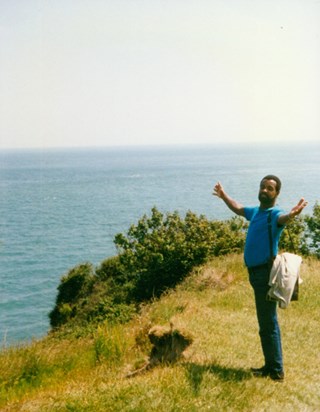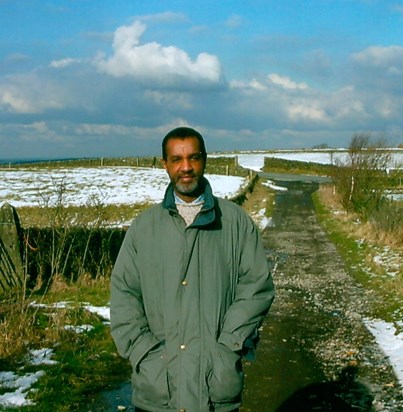
Ira O’Flaherty (1943-2025)
Sadly, when searching for information about Ira, I learned that he had died the previous year, in March 2025. He worked in production at Granada Publishing in Golden Square and Park Street and took an active part in our one-day walkout. I must have met him once more after I left. He was a lovely and gentle man and I remember him with much warmth. It is such a shame he wasn’t alive as these pages came together. – Peter Sinclair
The following recollection by Tony Zurbrugg was published in Radical Bookselling History Newsletter, 10 June 2025, pp 13-14.
I first met Ira O’Flaherty around 1980, when he was based in Coldharbour Lane in Brixton, I was a rep and visited Ira’s company, Bookscan Library Services, to show new titles. Ira was always one of the buyers I most enjoyed visiting, always courteous, kind and providing cups of tea.
For many years, Bookscan operated a system of sending approvals to certain supportive local authority libraries, perhaps most around London but some further afield. If for example, he had 12 head libraries working with him, he might buy 12 copies of a title he selected and send one copy to each library. Some might be rejected and returned, some might spark further orders as books were ordered for sub-libraries. Books might be supplied serviced, i.e. ready to go on a library shelf, stamped with the name and address of the library concerned, an issue sheet and other details.
Services such as these worked well so long as local libraries had some autonomy and were not so constrained. For some time, libraries were concerned to expand their holdings, to recognise diversity, perhaps to challenge racism and to have selections of books to reflect the diversity of local communities – Black, Asian, Irish, etc. For a time in the early 1980s various booksellers – New Beacon, Soma, Rolex[s], Ruposhi Bangla, the Africa Book Centre and others – might regularly or occasionally supply books chosen by local librarians. Sometimes, towards the end of a financial year, an urgent order might be placed to use up a library budget surplus. Bookscan was perhaps the foremost supplier of diverse multicultural books to libraries.
The service that Bookscan provided was very important in working to diversify the range of materials available in public libraries, countering a purely white agenda. For my part, as a rep, I would show information from various publishers, and hope that libraries ordered more and returned little. The book trade might have large players celebrating each other’s mainstream achievements; beyond them, Bookscan was perhaps the biggest of the smaller specialist library suppliers working for a diversity agenda, and in this Ira O’Flaherty deserves recognition as a great diversity pioneer working with dedication over decades to broaden British library culture.
Ira was able to employ staff for many years, but business became ever more difficult. He worked assiduously and for long hours, often alone, searching for new books and new publishers. He told me he might work in the evening catching up on administrative tasks, or reading catalogues.
Library managers – and political directors – changed policies, and the system of sending books on approval eventually stopped. The criteria of efficiency and productivity were highlighted, meaning perhaps that books for minorities were less important, since they might be taken out less often. Bigger companies might give bigger discounts, and library suppliers might be bought up by wholesalers, who were better placed to offer more generous terms. Ira replaced his approvals system with systems suggesting selected books.
Bookscan worked from premises in the Central Books building in Hackney Wick, then Freshwater Road, Chadwell Heath, circa 2015-2018. Living south of the Thames and travelling there demanded from Ira a commuting time of an hour or more each day. At that time, I was based upstairs in the same building, and every so often we would meet on the train platform on the way home and chat. Ira was perhaps in his late seventies by then, but he continued to plug away; eventually it was time to stop. Covid then drove me away from a similar long London commute and we had little contact thereafter.